From 12 August 2026, most articles of the PPWR regulation become applicable, and packaging becomes a fully regulated product in its own right. If you work in packaging, and not only then, the questions you need to ask when choosing a material, designing a dieline or writing ‘sustainable’ on a box are changing.
In this article, you’ll find everything you need to know: what matters right now, what’s coming later, and what’s worth sorting out today.
What is the PPWR (Regulation (EU) 2025/40) and when does it come into force
PPWR stands for Packaging and Packaging Waste Regulation: Regulation (EU) 2025/40 on packaging and packaging waste. It has been in force since 11 February 2025, and many of its articles become applicable from 12 August 2026 — and this is the detail that really matters: it’s a regulation, not a directive. A directive is a framework that each member state interprets in its own way, on its own timeline; a regulation is a single law that applies identically everywhere, from the same day: from 12 August 2026, the same rule applies, word for word, in all twenty-seven EU countries.
It replaces a directive over thirty years old (94/62/EC) with a framework of 71 articles and thirteen technical annexes. And here comes the most important point in the whole article: the PPWR is not yet a fully defined piece of legislation. Some articles are already written and binding from 12 August 2026; many other obligations — starting with recyclability criteria and labelling — depend on delegated and implementing acts that the European Commission has yet to publish. In practice: some deadlines you can already mark in your calendar, others remain a framework still being defined, and it’s worth telling the two apart before rushing to redesign everything.
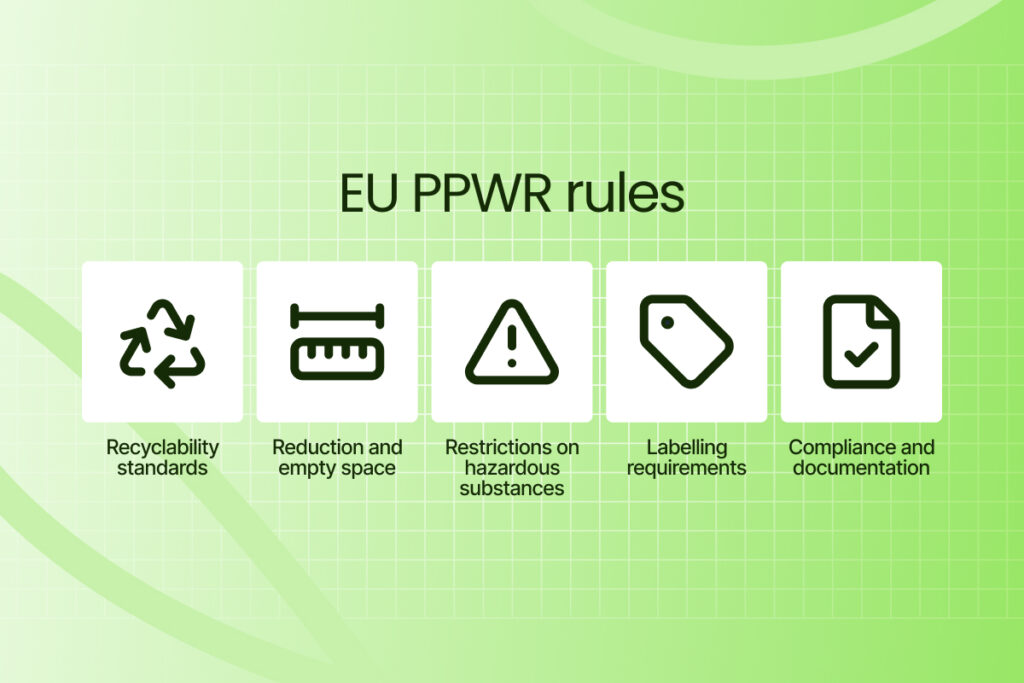
The bulk of the obligations doesn’t all arrive at once. From 12 August 2026, technical documentation, the declaration of conformity and restrictions on certain substances all kick in, among other things. The harmonised labelling for materials is expected in 2028. The 50% empty space cap and the recyclability classes — the two measures most talked about — only arrive from 2030. And this is where the most common misunderstanding creeps in: some people push everything back to 2030, when the technical documentation needs to be prepared now.
PPWR packaging regulation: what changes for cardboard
PPWR legislation doesn’t treat every material the same way, and cardboard starts from a favourable position. The recycling target set for 2030 is 85%, and Italy is already stably above 90%. The minimum recycled content requirement, which weighs heavily on plastic, simply doesn’t exist for paper. Be careful, though: being the easiest material to recycle doesn’t automatically mean being compliant. What counts is the specific box you’ve designed, not cardboard as a category.
PPWR recyclability classes: what changes from 2030
From 1 January 2030, every piece of packaging will be classified by recyclability: class A from 95% and above, B from 80%, C from 70%. Below 70%, packaging is considered non-recyclable and can no longer be placed on the market. From 2038, only A and B remain.
There’s a decisive caveat, though: the classes will depend on a European methodology and design-for-recycling criteria still to be set through delegated acts, expected but not yet published. What’s already clear is the direction: rewarding mono-material packaging and penalising anything that’s hard to separate. A printed cardboard box that goes straight into the paper stream starts at an advantage; the same box with a plastic film window or lamination will be a more complex case to manage.
The empty space limit for e-commerce packaging
From 1 January 2030, the minimisation principle also comes into force: packaging weight and volume reduced to what’s necessary to protect the contents, not a millimetre more. No more double bottoms, inflated walls, or technical voids that only exist to make the box look fuller.
Also from 2030 (or 3 years after the relevant implementing acts come into force, if later), the limit becomes a precise figure for anyone filling multi-item, transport or e-commerce packaging: empty space cannot exceed 50% of the total volume. A detail few people notice: filling material counts as empty space, not as content. If you compensate for an oversized format with scrunched-up paper, you haven’t solved anything — you’ve just moved the problem. There’s only one way to genuinely meet the limit: match the box to the product, not the other way round. Bespoke formats, fewer variants — that way you stop paying volumetric weight for empty air.
What the PPWR’s harmonised labelling means
From 12 August 2028, or 24 months after the relevant implementing acts if these arrive later, all packaging will need to carry a harmonised European materials label, with standard pictograms identical across the Union: no more different symbols from one country to another. National labels are set to disappear. However, the exact content of the label and the final pictograms will be set out in the Commission’s implementing acts, which have not yet been published.
For graphic designers, this is less theory and more millimetres: an extra space to find on a dieline already packed with logos, mandatory text and codes. It’s better to plan for it now in new artwork than to redo it a second time once the final pictograms and any QR codes are published.
PFAS and heavy metals: what can no longer be in the box
The PPWR (Article 5) introduces quantitative limits on PFAS in packaging intended for food contact: 25 ppb for a single PFAS, 250 ppb for the sum of PFAS, 50 ppm for total organic fluorine if measured as a screening parameter. However, the harmonised methods for verifying and demonstrating compliance are still being defined by the European Commission. In the meantime, operators are relying on the best analytical methods available, often based on determining total organic fluorine (TOF/EOF) as a screening step, supplemented where necessary by targeted analysis of individual PFAS.
The old limit inherited from the previous directive also remains: lead, cadmium, mercury and hexavalent chromium combined must not exceed 100 mg/kg.
This mainly concerns anyone using grease-resistant cardboard for fatty foods: think packaging for fried food or greasy baked goods. If that’s your case, material checks need setting up with your suppliers well in advance, bearing in mind that the methodological framework is still evolving. Here, the PPWR sits alongside Regulation (EC) 1935/2004 on food contact materials: one doesn’t replace the other — both apply together.
What is the PPWR declaration of conformity
Of all the PPWR’s obligations, this is the one worth acting on first: before being placed on the market, every piece of packaging must be accompanied by technical documentation and an EU declaration of conformity. Annex VII lists the elements the documentation must contain, but there’s no single template valid for everyone: the actual content varies depending on the type of packaging, the material and the applicable conformity assessment. If you already had structured documentation under the old directive, it’s a good starting point, but it still needs updating: the regulation’s criteria are different.
Who is responsible for the PPWR
This needs a preamble, because it’s the point that causes the most confusion. The PPWR distinguishes between several roles — including the packaging manufacturer, the producer for extended producer responsibility (EPR) purposes, and other economic operators — and assigns different obligations to each. These don’t always overlap, and understanding which role you play in your supply chain is the first step to knowing what actually applies to you.
In general terms: whoever places packaging on the EU market has documentation-related responsibilities, but how these are shared between whoever manufactures the packaging, whoever fills it and whoever puts their brand on it depends on the specific case — on how and by whom the packaging is manufactured, whether it’s made on behalf of a third party, whether it’s modified, and whose brand it carries. For this reason, if you buy custom packaging, it’s worth clarifying with your supplier, and with a consultant if needed, who takes on which obligations: it’s not a detail you can take for granted either way.
There’s also registration with extended producer responsibility (EPR) schemes, which remains a national requirement — in Italy the reference body is CONAI, in France Citeo, in Germany the dual systems — and needs managing country by country, in every market where you sell.
One practical piece of advice, valid in every case: map what you’re actually using. Materials, weights, non-paper components, any barrier treatments. It takes more time than it looks like, and it’s the step almost everyone underestimates — as well as being the basis on which any conformity assessment is then built.
Where to start: five concrete points
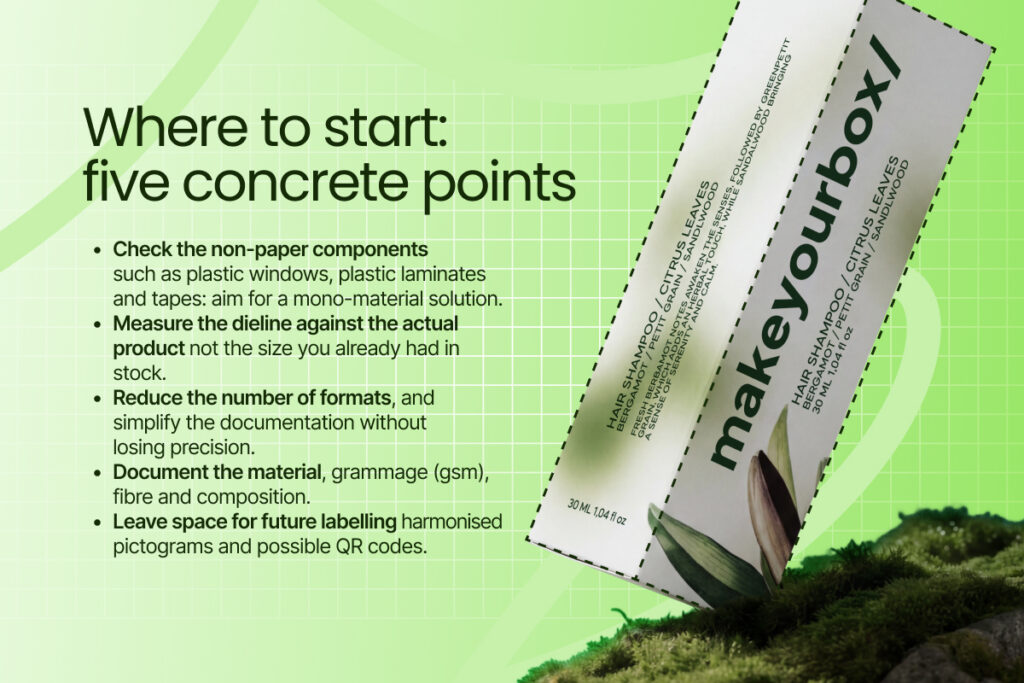
1. Non-paper components. Film windows, laminations, tapes, barrier coatings: each one needs justifying or removing. A mono-material cardboard structure is the easiest position to defend once the 2030 recyclability classes arrive.
2. The relationship between format and product. Measure against the real product, not the format you already had in stock. A bespoke dieline solves the empty space problem at the root, whereas a standard format forces you to fill it with something else.
3. How many formats you actually need to keep. Reducing the range simplifies documentation, but only if the measurements stay accurate. The right number of formats is calculated from the product.
4. The material, and how well you can document it. Weight, fibre type and composition are data you’ll need to document your design choices. If you haven’t yet decided which cardboard to use, start from the differences between material types.
5. The space for the labelling that’s coming. In new artwork, already leave room for the harmonised pictograms and any QR code. It costs less to plan for it now than to redo the artwork in two years’ time.
How much can you still write ‘sustainable’ on the box
Rules on environmental claims don’t all originate from the PPWR. The regulation governs certain aspects of packaging; others, particularly the fight against greenwashing in communication to consumers, fall under the Empowering Consumers Directive and the future Green Claims Directive. It’s worth keeping in mind: when we talk about what to write on the box, several rules come into play together.
For the part covered by the PPWR, the logic is clear: an environmental claim on packaging must be specific (about what it refers to: that box, part of it, or the whole range) and backed by documentation, and it’s forbidden to use labels or symbols that could confuse consumers about sustainability or recyclability where harmonised rules already exist.
In practical terms: a generic, unsubstantiated claim is a risk, not an advantage. A precise, verifiable claim holds up instead — a recognised certification, a mono-material structure, a reduced weight compared with a previous version — backed by the data that supports it. This applies when you’re the one buying, too, not just selling: if a supplier offers you packaging that’s ‘PPWR-compliant’ without further detail, ask what it’s compliant with, for which specific box, and with what documentation. Compliance concerns one specific piece of packaging and its use, not an entire catalogue.
The right time to review your packaging
If you’re reviewing a piece of packaging with these deadlines in mind, the point at which decisions cost the least is at the design stage. With the online configurator, you can compare formats and materials and download the dieline before committing to a print run, or speak to our team if your project needs a dedicated assessment.
This article is for information purposes only and does not constitute legal advice. The PPWR is legislation that is, in part, still being defined, with several obligations depending on delegated and implementing acts not yet published: the information given here reflects the framework available as of the update date and may change. For the full, up-to-date text, please refer to Regulation (EU) 2025/40 on EUR-Lex, the European Commission’s guidelines, and CONAI’s dedicated page.