At a glance
- EPR is an internationally recognized regulatory principle that shifts responsibility for packaging waste management from public authorities to businesses.
- It’s not just about those who produce packaging: it’s also about those who bring it to market.
- The UK has one of the most advanced and rigorous EPR systems in the world, which will be operational by 2024.
- In the EU, each country has its own national system; the PPWR, currently being adopted, will harmonise the technical criteria while maintaining the national systems.
1. What is EPR, and where does it apply?
EPR (Extended Producer Responsibility) is a regulatory principle present in dozens of countries around the world, from Europe to North America, from Asia to Australia, which transfers the cost of managing packaging waste from public authorities to the companies that place that packaging on the market.
This is a global regulatory approach, adopted across different systems and levels of maturity depending on available infrastructure. In the European Union, for example, each country maintains its own national EPR scheme—in Italy, there’s CONAI, in France, CITEO—with its own tariffs and calculation criteria. The PPWR (Packaging and Packaging Waste Regulation), the new European regulation currently being adopted, will not create a single European EPR, but will impose harmonized technical criteria on the 27 existing national systems.
The United Kingdom, for its part, has built one of the most structured and transparent EPR systems in the world, already in force since 2024, with concrete registration, reporting, and possible financial contribution obligations for companies with a turnover of more than £1 million.”
2. Who is the obliged entity in the UK system?
This is the most frequently asked and often misunderstood question. In the British system, the answer depends on where you operate, who buys the packaging, and your role in the supply chain.
The concept of the first UK owner: If you operate in the UK and purchase packaging from a foreign supplier (for example, an Italian company like Packly), you are almost certainly the obligated party: you are the first UK owner, the first entity in the UK to acquire ownership of the packaging. This means that you are the one who has to register, collect, and declare the data and pay contributions.
B2B does not automatically mean “non-domestic”. One of the most common mistakes is to think that B2B sales are exempt from EPR requirements. This isn’t the case. The classification that matters is the packaging’s final destination, not the sales channel. If you purchase cardboard boxes or cases to package products that you then sell to end consumers through physical channels or e-commerce, that packaging is classified as household (domestic). And EPR contributions for domestic packaging are the most significant. In practice, your B2B packaging can become domestic as soon as it reaches the end consumer.
3. How much economic impact could EPR have on the UK?
EPR contributions in the UK system are calculated on a per-tonne basis for material placed on the market. The type of material is the main variable: the more difficult it is to recycle, the higher the fee.
For the two-year period 2025–2026, the UK government has confirmed these basic tariffs:
| Material | Tariff 2025 | Red tariff 2026 (indicative) |
| Paper and cardboard | £196/ tonne | £250/ tonne |
| Fiber-reinforced composite | £461/ tonne | £630/ tonne |
The law came into force in 2026 with the mandatory ecomodulation, based on the Recyclability Assessment Methodology (RAM), which classifies each package into three categories:
| Class | Meaning | Tariff impact |
| Green | Highly recyclable packaging | Lowest rate |
| Orange | Recyclable with limitations (adhesives, inks, plastic components) | Intermediate rate |
| Red | Difficult to recycle: significant obstacles in the process | Highest rate |
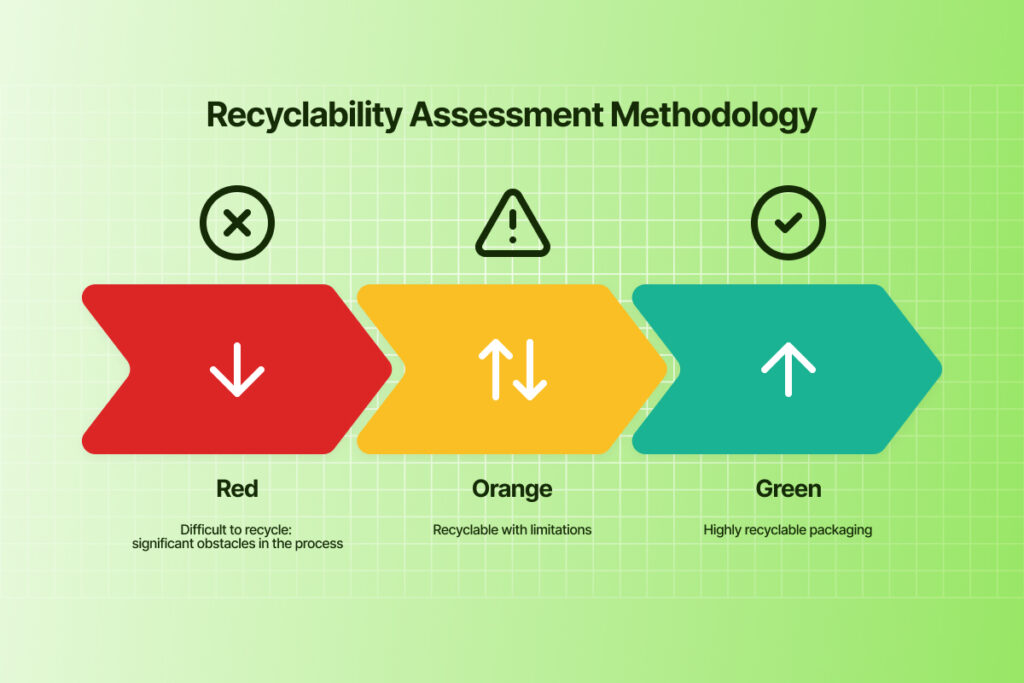
Starting January 1, 2026, cardboard packaging containing small amounts of plastic (≤5% by mass) can be classified as pure paper/cardboard, with significantly lower tariffs. This distinction could significantly affect costs.
4. What can increase the cost of packaging?
With the 2026 ecomodulation, every design choice becomes an economic variable. It’s not just the primary material, but also the construction details that determine the final classification of the packaging.
Here are the elements that can move a paper-based packaging from the green class to the orange or red class:
- Plastic coatings and coatings that exceed certain quantitative thresholds
- Non-water-soluble glues and adhesives that do not separate during pulping
- Plastic windows or other components that cannot be separated manually
- Barrier treatments and moisture-resistant dispersions
- Inks in quantities exceeding the limits set by the recyclability coefficient
Conversely, packaging designed with simple features—water-soluble glues, minimal or no coatings, and the absence of non-separable plastics—can be classified in the green band, with lower contributions. Designing sustainable packaging is not only an ethical choice, but also an economic one.
5. What should I ask my packaging supplier?
To comply with EPR reporting obligations, you will need accurate data on the packaging you purchase, especially if you operate in the UK. British legislation requires you to declare, with ever greater precision, the exact composition of the packaging you place on the market.
EPR UK Compliance Checklist – What to ask your supplier:
- Total weight of the packaging and of each individual component
- Type of material (flat cardboard, corrugated, composite, etc.)
- Presence of coatings, glues, or plastic films
- Distinction between primary, secondary, and tertiary packaging
- Intended use:household(domestic) ornon-household
A technically competent supplier should be able to provide you with an “EPR data pack” for each SKU (Stock Keeping Unit) or order: a structured document with weight, materials, and construction characteristics, ready for reporting. If your supplier is unable to provide this data, it’s a significant sign: transparency in the packaging supply chain is becoming a basic requirement, not an option.
6. UK vs Europe: How different are the systems?
While sharing the same underlying principle, the British EPR system and the European ones are structurally very different:
| Topic | United Kingdom | UE-27 |
| System | National only (PackUK) | 27 distinct national systems |
| Contributions | Direct, per ton | Paid to local consortia (CONAI, CITEO, etc.) |
| Average rates | Taller and more transparent | Lower, very variable by country |
| Eco-modulation | Mandatory from 2026 (RAM) | Already active in some countries, but not uniform |
| Reporting | Very detailed, biannual | Annual, medium detail |
| Attention to design | Very high (coating, glues, plastics) | Less technical pressure on individual details |
| Who is obliged (foreign supplier) | The first UK owner | Often, the foreign seller (with variability) |
The PPWR will not create a single European EPR: contributions will remain national, managed by local consortia. However, it will impose harmonized technical criteria—particularly on ecomodulation—progressively bringing European systems closer to the model already adopted by the United Kingdom.
In short, if you sell in the UK, you’re already operating within a more demanding system. If you also sell in Europe, prepare for an evolution in that direction.
7. What does EPR mean for my company?
EPR is redefining packaging not just as a marketing or product protection tool, but also as a regulatory, economic, and competitive variable. Companies that integrate recyclability criteria into their packaging choices achieve tangible benefits on multiple fronts: reduced future costs, less exposure to regulatory risk, an improved sustainability profile, and competitive differentiation from less-prepared competitors.
It’s not about anticipating future obligations. It’s about recognizing that packaging is already a strategic lever today and that today’s design choices determine the costs you’ll pay tomorrow.
Conclusion
Designing good packaging today means reducing waste disposal costs tomorrow. Packly creates cardboard packaging with full awareness of both UK and international regulations, helping you make choices that protect your business now and in the future. Trust our experience and expertise for an effective, scalable, and sustainable packaging strategy.